
Vajpayee had, on Sunday, asserted that he would consider attending the SAARC summit if Pakistan completely stopped cross-border terrorism before the event. \n\n\n\n\n\n\n\n\n\n\n\n

Pakistan is once again becoming a frontline State in big-power rivalry. But this time around, Pakistan stands to gain out of its geography, observes Ambassador M K Bhadrakumar.

The PM said that countries sponsoring, aiding and funding terrorism must be held accountable.
The visit is in his capacity as the chairman of SAARC.
Russia has promised all possible support to Pakistan in dealing with catastrophic floods, even as the second Russian Il-76 cargo plane with emergency relief is scheduled to land in Islamabad on Thursday.

According to the photos published by the Pakistani media, Swaraj and Qureshi were seen seated next to each other.

'Lingering border disputes and fierce geostrategic competition in South Asia between China and India are likely to temper any cooperation Beijing might hope to achieve with New Delhi in the SCO,' says P K Vasudeva.
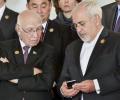
He did not mention the issue of Jammu and Kashmir.
Leading South Asia analysts in the United States have slammed President Obama for his stout defense of Islamabad as committed to non-proliferation and a safe steward of its nuclear weapons arsenal, and described his comparing the safety and security of US and Pakistan nuclear weapons is "unhelpful and disingenuous".

United States President Barack Obama has assured Pakistan Prime Minister Yousuf Raza Gilani that Washington has no plans to control Islamabad's nuclear programme.
China has assured Pakistan that it will support the latter during the forthcoming nuclear summit in Washington on all issues, including Islamabad's long standing demand for a civil nuclear agreement with the United States.According to sources privy to a special meeting of the parliamentary committee on national security, which was presided over by Prime Minister Yousuf Raza Gilani, Beijing has assured of all help during Gilani's upcoming US visit.
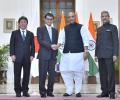
The India-Japan 2+2 dialogue added strategic heft to the special relationship in the wake of growing Chinese assertiveness on regional affairs, points out Dr Rajaram Panda.

'Whatever comes in the minds of the Pakistani generals and Pakistan military, they just go for it.' 'They do not care about the consequences for their country or the consequences to the people of Pakistan.'
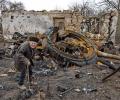
Any Indian government at this juncture would have voted and spoken exactly this way. It isn't just about the vast Indian dependence on Russian-origin military equipment. It is also about trust, asserts Shekhar Gupta.
Prime Minister Manmohan Singh on Monday acknowledged that there was tremendous pressure on him to retaliate militarily against Pakistan in the aftermath of 26/11, but said he's glad he exercised restraint.

Sources in the Indian Intelligence Bureau told rediff.com that Madhuri Gupta, who was working in the press wing of the Indian High Commission in Pakistan, was passing on sensitive information to Pakistani intelligence agencies for kickbacks.
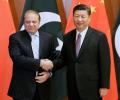
His remarks came in response to the India-US joint statement issued after the talks between Prime Minister Narendra Modi and US President Donald Trump.
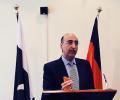
India and Pakistan should move from confrontation to cooperation, Pakistan's High Commissioner Abdul Basit on Tuesday said while adding that Prime Minister Nawaz Sharif is keen to normalise bilateral relations.

India has said that the terrorist attack in Uri in Kashmir has highlighted Pakistan's desire to use "poison" instead of dialogue as it lodged a strong protest against Islamabad at the Non-Aligned Movement summit at Margarita Island in Venezuela for its "mischievous" and "malignant" support to terror.
Pakistan on Thursday said it will approach upcoming bilateral meetings with India, including one between the two prime ministers, with an 'open mind', in the hope for resumption of the composite dialogue, which have been stalled after the 26/11 attacks. The foreign secretaries will hold talks before a planned meeting between Pakistan Prime Minister Yousuf Raza Gilani and his Indian counterpart Manmohan Singh.
In the first top-level meeting between India and Pakistan since Mumbai attacks, Prime Minister Manmohan Singh will meet Pakistan President Asif Ali Zardari on Tuesday and convey New Delhi's "unhappiness" over Islamabad's inaction against the terrorism.
Prime Minister Manmohan Singh, during his interaction with the press after the conclusion of the Nuclear Security Summit in Washington, delivered some short, crisp answers on a host of issues.When he was informed that Pakistani Prime Minister Yousaf Raza Gilani had told the press that he had invited the PM to Islamabad and the latter had accepted the invitation, Dr Singh quipped to much laughter, "I am hearing it for the first time."
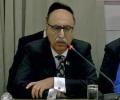
Striking a conciliatory note amid rising tension in ties, Pakistan today said it does not want to live in "perpetual hostility" with India, noting time has come for the two neighbours to decide whether status quo should continue or a new beginning be made.

In an interview with Outlook magazine, Foreign Minister Shah Mehmood Qureshi, in an apparent volte-face, said Pakistan actually never handed any dossier to India during Prime Minister Manmohan Singh's meeting with Yousuf Raza Gilani on the sidelines of the NAM summit at Sharm-el-Sheikh in July.

The Chinese envoy said that the India-China bilateral ties can't take the strain of another Doklam episode
A news report claimed India has been helping the Muttahida Qaumi Movement with funds and training to create unrest in Karachi.

Prime Minister Manmohan Singh met Pakistan Prime Minister Yousuf Raza Gilani on the sidelines of the Non-Aligned Movement summit in Sharm El Sheikh in Egypt on Thursday.Sources indicate that while Dr Singh will seek a firmer commitment on tackling terror from his Pakistani counterpart, Gilani might rake up the contentious issue of Kashmir during the talks. The composite dialogue between India and Pakistan had come to a standstill after the terror attack on Mumbai in November

As Xi is due to arrive in Goa on Saturday to take part in the BRICS Summit, Chinese foreign ministry spokesperson Geng Shuang said the relations between India and China made "great headway" despite some "disputes" but there was no change in in Beijing's stand on the issues of NSG and Azhar.
Pakistan President Asif Ali Zardari on Saturday declared that his country will not be the first to use nuclear weapons against India and would work towards opening trade, besides underscoring that Kashmir belonged to the Kashmiri people.

'The US appears to think that Pakistan is highly vulnerable today due to its economic crisis and one more turn of the screw may bring about desired results,' says Ambassador M K Bhadrakumar.
Prime Minister Manmohan Singh is likely to meet his Pakistani counterpart Yousuf Reza Gilani on the sidelines of the 15th SAARC Summit in Colombo against the backdrop of a spurt in terrorist activities against Indian installations and infiltration across the Line of Control.
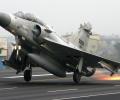
"The Indian government approached asking us to open the airspace. We conveyed our concerns that first India must withdraw its fighter planes placed forward," Nusrat told the committee.

At a time when China is trying to make its foray into South Asia, India should use its shared history to strengthen its ties in the region, says Dr Rup Narayan Das.
The joint Anti-Terrorism Mechanism met for the third time after it was set up in line with a decision taken during a meeting between President Pervez Musharraf and Prime Minister Manmohan Singh on the margins of the Non-Aligned Movement summit in Havana in September 2006. According to reports, India may raise the recent terror attacks in Jaipur, Ajmer and Hyderabad in the meeting while Pakistan is expected to sought details of last year's Samjhauta Express blast.
India and Pakistan will discuss measures to counter terrorism and exchange information to assist in investigations related to terrorist acts during a meeting in Islamabad on June 24.
Deora's visit assumes importance in view of Musharraf's proposals to China and China's quest for shorter, safer and commercially viable routes for importing gas and oil.

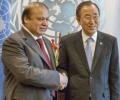
The frosty Indo-Pak ties briefly gave way to some warmth when a smiling Prime Minister Narendra Modi and his Pakistani counterpart Nawaz Sharif on Thursday shook hands and exchanged pleasantries, but India cautioned against reading too much into such "courtesies".

Barely a week after Prime Ministers of India and Pakistan broke the deadlock and decided to re-engage, the two countries were back to a blame game over ceasefire violations with both sides lodging protest with each other.
